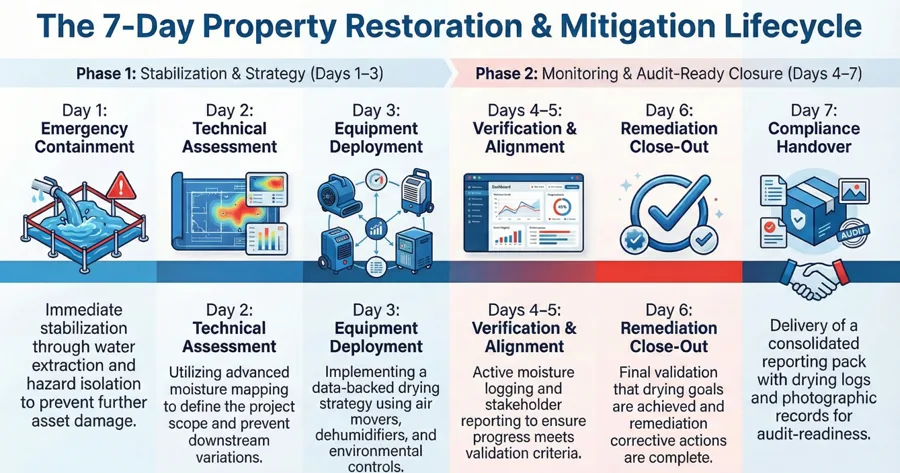
Day 1: Emergency Response and Risk Containment
The priority is stabilisation.
Our team implements emergency response measures to contain risks, protect assets, and prevent further damage. This may include water extraction, hazard isolation, and setting up containment.
Early documentation establishes a clear project baseline, and proper safety procedures are essential during this phase, especially when managing water damage hazards, as detailed in our health and safety guide.
Day 2: Technical Assessment and Scope Definition
Moisture mapping and technical assessment define the extent of impact. Using advanced moisture detection tools, restoration technicians document the affected areas and determine the full scope of damage.
A clear and documented scope is established to prevent downstream variation and ensure the restoration project follows a structured and controlled workflow.
Day 3: Drying Plan and Equipment Deployment
A structured drying strategy is implemented based on collected moisture data. Professional drying equipment, such as air movers, dehumidifiers, and environmental controls are deployed to accelerate the water damage restoration drying process.
Equipment placement and environmental controls follow recognised restoration methodology to achieve optimal drying performance while protecting structural materials.
Day 4: Monitoring and Environmental Verification
Active monitoring ensures drying objectives are progressing as planned throughout the restoration process.
Technicians log moisture readings, adjust equipment, and verify environmental conditions to determine if materials can be restored or need replacement.
This is essential in compliance-driven environments that require clear data. Safety controls, like hazard identification and fire safety signage, ensure a safe working environment during mitigation efforts.
Day 5: Reporting Updates and Stakeholder Alignment
Transparent reporting minimises uncertainty during restoration. At this stage, progress reports are generated, data is evaluated, and stakeholders—including insurers, asset owners, and facility managers—align on next steps, timelines, and validation criteria.
Clear communication ensures the restoration project continues efficiently while maintaining documentation integrity.
Day 6: Drying Validation and Remediation Close-Out
Drying validation confirms that defined drying goals have been successfully achieved.
Where remediation services are required — such as mould remediation or fire-related restoration works — final corrective actions are completed in line with the documented project scope.
Verification data is recorded to support defensible project completion. For a deeper understanding of containment and removal procedures used in mould remediation, refer to this effective mould remediation guide.
Day 7: Handover Readiness and Reporting Completion
Final verification data, drying logs, and photographic records are compiled to support project completion.
A consolidated reporting pack is prepared to ensure a compliant, audit-ready closure of the restoration project, providing stakeholders with full documentation of the restoration works performed.
A structured restoration lifecycle ensures precision and accountability across emergency response, drying, remediation, and reporting.
By following a defined 7-Day End-of-Life (EOL) Project Lifecycle, restoration teams achieve faster stabilisation, improved communication, and more reliable restoration outcomes.
You can request a restoration assessment here or call 1300 899 276 to arrange immediate assistance.